Help Center
Where Can I find hot tub owners manuals & Pre-delivery agreements?
You can find both Artesian and Hot Spring Owners Manuals and Pre-delivery Agreements in our Spa Owners area.
What are the Benefits of a hot tub?
Family Time
Hot tubs offer a chance for families to gather together without the distraction of TV, cell phones, or computers so that they can reconnect and talk about their day. As children grow older, get more friends and join more school activities, parents and children tend to grow apart. It is amazing to see how parents and their children will communicate and regain the togetherness from the addition of a spa. Everyone has fun in a spa, and isn’t it a great thing when parents and their children can have fun together.
Improved Sleep
Sitting in hot water raises your body temperature and enhances your ability to fall asleep and sleep longer as your body works to lower your temperature back to 98.6 degrees. A spa aids in the falling asleep process. When someone falls asleep, the body naturally cools down. If you go into the spa before going to bed, your body temperature will increase because the temperature of the water will normally be higher than your body temperature. Your body temperature will begin to drop once you get out of your spa. This will help your body to continue right into sleep mode when your temperature naturally drops.
Relief from Arthritis
The hot, pulsating water increases circulation and takes the stress of gravity off of aching joints, relieving pain and improving flexibility. Many doctors will prescribe hot water therapy to arthritis patients depending on the type and severity. It is not uncommon to see people that have to take medications to stay mobile and active to be relieved from their pains, medication free, from the use of a spa on a regular basis. The relief comes from a combination of activities in the body which the spa causes. Being buoyant submerged in water releases about 85% of the pull of gravity off of joints. Being submersed in water, that is hotter than the body temperature increases blood flow and helps heat up stiff muscles, joints, and bones.The action from the powerful yet soothing jets helps to work the muscles and loosen them up while increasing blood flow to different areas of the body.
Exercise
It is easier on the joints to exercise in water than it is on land. With many hot tubs deep enough to stand in, they offer the opportunity to do chair exercises.
Reduce Stress
In today’s day and age, stress can be linked to many detrimental health conditions, such as heart conditions, anxiety, and obesity. Yet if you were to ask most people what they are doing to relax and relieve stress, they couldn’t answer you. If they did they would say either nothing or not enough. Owning a spa is a great form of stress relief simply because it can give you thirty minutes a day away from the hectic stressful surroundings in your life. Something you can look forward to coming home to, something to enjoy. The soothing sounds and motion of a hot tub's water can greatly reduce stress and anxiety, promoting your ability to unwind and relax naturally.
Massage
Hot tub jets can offer either a gentle or more forceful massage, targeting areas you need it most.
Diabetes
Sitting in hot water lowers blood sugar levels for people with Type 2 Diabetes.
Headaches
The hot water combined with vascular dilation can provide pain relief associated with tension headaches.
Weight Loss
Your body will burn a small amount of real calories as it works to cool your temperature down from being in the hot water. In a study participants experienced weight loss when using a hot tub regularly (30 minutes per day for 3 weeks at a time) combined with eating healthy and exercising.
Back Pain
Hot tub therapy has both long term and short term benefits for people experiencing lower back pain. A study showed that after 3 weeks of consistent hot tub therapy, participants saw more improvement in health status and decreased their use of anti-inflammatory medication.
Planning for a Spa
When you have finally made the decision to get a spa it is an exciting time. There are a few things that need to be decided when planning for a spa. Some of these things include:
Diameter in feet x by Diameter in feet x average Depth x 5.9
Example: 18 x 18 = 324. 324 x 4 = 1296. 1296 x 5.9 = 7,646 gallons
Let's make sure you will be prepared for your spa and take a few minutes to make this an easy transition.
Where are you going to put your spa?
The first thing that needs to be decided when planning for a spa is where it is going. Everyone's yard is unique and different so there is not a specific answer for this. With that being said there are a few things that need to be kept in mind when making this decision. The first thing to keep in mind is the surface that the spa is going to sit on. A spa must sit on a firm, level surface. This includes a 4 inch cement slab (manufacturer recommended), deck, paver stones, brick patio, or a prefab surface that can be purchased from American Sale. For all of these surface options you need to make sure that they are properly installed, level and can hold the weight of the spa, water and the people in it. Gazebos and enclosures are also available for privacy. Next thing is the view. When deciding where the spa is going to sit in the backyard, walk around the yard with one or a couple folding chairs with your family or friends and position them as if you are sitting in a spa. Now every spas layout is different but until you decide on a specific model place the chairs in a U shape to get the feeling of where it is going to be. Sit in each chair and imagine sitting in the spa. What are your views? Does anyone have a good view of you? While doing this you can also get a good idea of what size spa you want. Another thing to keep in mind is whether or not a service technician can get to all four sides of the spa and work on it comfortably. Most technicians will need 2 to 3 feet of space to work on your spa. 95% of the time, any service work that would take place is from the front panel of the spa.
How are you going to get the spa in your yard?
When purchasing a spa from American Sale we will get the spa to your chosen area. We will just need a little help from you to get the area ready for us to transport it from the unloading site to the final destination. We will bring the spa to your home on a flat bed truck. When we take the spa off the truck it will be tipped on its side onto a cart that has wheels that can safely role through your lawn without causing any damage.
Your responsibility is to provide us with a level, unobstructed pathway from the unloading site to the spas final resting spot. Therefore make sure all debris, gates, fences, door, windows are cleared or removed for the spa to be able to fit through any tight areas. Now if your final destination spot for the spa is an elevated deck or partition over 30 feet, you may need to consider renting a crane. American Sale can send one of our delivery professionals out to your home to determine if that will be necessary. In most cases we can make due with what is given, but you may need to supply some extra manual labor. We are also very experienced in working with the crane company of your choice to make sure everything goes smooth.
Once we get through any obstacles that may be in our way, we place your spa on the level surface you have supplied us and hook up any accessories that you may have received with the spa. So you are only responsible for filling it up with water and have a certified electrician hook it up according to your spas owners' manual. That's it!
What types of utilities are needed to get a spa operating and functional?
All of the spas that American Sale sells only require an electrical hook up. Many people believe that a spa needs a water line, that is not true. All of the spas that we carry are self contained and can be filled up with a garden hose. When filling your spa you need to place the garden hose in a specific filter inside the filter compartment on the spa. Our delivery professionals will point out to you which filter that one is when they delivery your spa. The reason for this is to prevent any air locks in your equipment. By filling it from the filter, the spa is filled from the inside out and that will not allow any air bubbles to get stuck in your heater or circulation pump.
The electric hook up on your spa depends on what brand and model you have. Most of our spas require a 230V 50 AMP service dedicated for the spa. This is a hardwired directly into the spa. So you need to make sure that you have 50 AMP's available in the main electric panel in your home that can be dedicated to the spa. Then, once your spa is delivered and filled with water, a certified electrician can run the electric from your main panel in your home to a sub panel. The sub panel can be purchased from American Sale. This sub panel has a GFCI 50 AMP breaker inside of it. It is to be placed at least 5 feet from your spa, but still within viewing distance of the spa. This sub panel is needed for a few reasons. First it is needed for any electric surges from your spa. It also serves as a quick disconnect for any emergency issues that may occur where you might need to shut the power off to the spa. And last it allows our service team to shut the power off to the spa from the outside so they can service the spa and you won't even have to be home for it. Please refer to your spa owners' manual for more specific details.
Hot Spring spas electrical service to your spa is a little different. Most still require a 230V 50 AMP service, but they hook up a little different. Instead of having a 50 AMP GFCI breaker inside of the sub panel they split it up. There is one 30 AMP GFCI breaker and one 20 AMP GFCI breaker. This requires a six wire hook up from the sub panel to the spa instead of the traditional 4 wire hook up. It is not a lot of extra work for the electrician and it gives your spa much more protection. By splitting the service panel up it allows them to run the heater on the 30 AMP breaker and the circulation pump on the 20 AMP breaker. The reason for that is because the number one failure on a spa is the heater. So if the heater goes out that will cause the GFCI breaker to trip, and if it is only 10 degrees outside and your spa does not have power it will eventually freeze and crack the shell and pipes in the spa. Well if you have a Hot Spring spa only the 30 AMP breaker will trip and the 20 AMP breaker is still running the circulation pump which runs 24 hours a day and will keep the water moving and prevent any chance of the spa freezing over.
There are also spas that plug in and only use 120V. These spas need a GFCI plug that has a dedicated 20 AMP's going to it. Keep in mind that some of these plugs are 20 AMP plugs which may require a different receptacle than what you may already have outside. Some of these spas have the option to be hooked up 230V or 120V. There is only one advantage to do the 230V over the 110V. Many people think that it is because the 230V will be less expensive to run. That is technically true, but it is only pennies difference. The major difference is that when you have 230V going to the spa it is pulling 30-50 AMP's, depending on the model, and it can support running the jet motors and the heater at the same time. When a spa is running off of 120V and is only pulling 15-20 AMP's and that is not enough to run the jet motors and the heater at the same time. So if you are in the spa with the jets on for more than 30 minutes, the water will start cooling down at a noticeable difference.
American Sale recommends to get electrical work done after the spa is delivered and in place. Then the electrician will have the owners' manual available to answer any questions they may have. It could also be an expensive mistake if the electric was short and the electrician had to re-wire everything. It just makes the most sense for it to all be done after the spa is delivered.
Do you need to get any permits?
The buyer shall be responsible for any permits required by your town pertaining to the purchase of a spa. If your town does require any type of permit they usually request that it is to have a GFCI protected power source, that the spa is UL or ETL rated, and that the spas cover has the ability to lock. Most spas fill all of these requirements. Any other requirements for a permit would be for a separate issue that pertains to the project for building a deck or patio.
Hot Tub Troubleshooting Guide
| Problem | Probable Cause | Solutions |
| Cloudy Water |
|
|
| Water Odor |
|
|
| Chlorine Odor |
|
|
| Organic Buildup/Scum Ring Around Spa |
|
|
| Algae Growth |
|
|
| Eye Irritation |
|
|
| Skin Irritation/Rash |
|
|
| Stains |
|
|
| Scale |
|
|
| No Heat |
|
- When there is a No Heat situation during the colder months, please make sure you leave the spa filled and DO NOT drain your spa. If the procedure above doesn't work, you can put a hair dryer in the equipment compartment and close it up. Leave the hair dryer in the compartment and on until service can be performed. |
Your Pool
Before we start, please download a FREE copy of our Pool Guide as a reference for all your questions! It's also a good idea to get the facts written down on your pool. The size of your pool determines almost everything from this point forward. The following is a chart listing the sizes of pools and their gallonage.
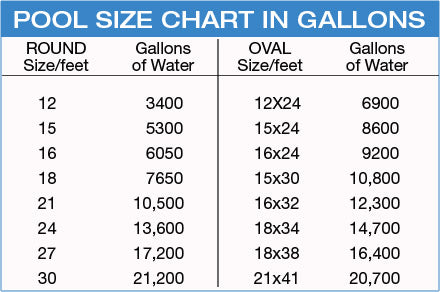
If your pool's size is not on this chart, you can determine its gallons by using the following formula:
Round Pool:
Diameter in feet x by Diameter in feet x average Depth x 5.9
Example: 18 x 18 = 324. 324 x 4 = 1296. 1296 x 5.9 = 7,646 gallons
Oval Pool:
Length in feet x Width in feet x average Depth x 6.0
Example: 18 x 34 = 612. 612 x 4 = 2448. 2448 x 6.0 = 14,688 gallon
Rectangle Pool:
Length in feet x Width in feet x average Depth x 7.5
Example: 18 x 34 = 612. 612 x 6 = 3672. 3672 x 7.5 = 27,540 gallons
How to open a pool for the season
Quick Tips on how to Open Your Pool
- - Remove water from the surface of your cover
- - Remove your pool cover
- - Hose down your pool cover, let air dry, and store your cover
- - Reattach your skimmer, and begin filling the pool
- - As your pool is filling, assemble filter and hook up hoses to your pool
- - Once the pool is filled half way through the skimmer opening, prime your filter
- - Use a leaf grabber to remove any heavy debris from the bottom of the pool
- - Vacuum (or vacuum to waste)
- - Check on baskets often and empty them
- - Once vacuuming is complete, begin to skim the surface of your pool
- - Test your water
- - Add the needed chemicals
- - ENJOY!!!!
When your pool isn't closed properly, opening can be such an exhausting task. You wonder, did my cover stay on? What does my water look like? How am I going to clean this swamp? If winterized properly, you shouldn't have to worry about any of these questions.
Saving the Cover
The cover is the first thing you need to tackle when opening your pool for the season. What you want to do is first remove the water that is sitting on top of the cover. We recommend using the Cover Saver or a small submersible pump. The Cover Saver creates a siphon that uses gravity to drain the water off, whereas a small submersible pump uses an electric motor to drain the water. Attach a garden hose and run the hose for drainage to somewhere in the back of your yard. Throw the Cover Saver or pump toward the center of the cover. With the weight of the submersible pump, all of the water should drain toward the pump.
REMEMBER: Do not run a submersible pump until it is submerged in the water. Running it without water can build heat, and ultimately cause the motor to burn out.
What will be left once the water is removed are a mess of leaves, twigs, dirt and debris. Your best bet is to remove those leaves and twigs using your skimmer net or leaf grabber before you take the cover off. Otherwise what could happen is all of that mess can fall right into your pool, leaving you with a bigger mess than you started with. It is easier to remove debris from surface of your cover than it is to remove it once it's in your water.
Now remove any cover clips or water bags used to keep the cover on (filled with chemically treated water, be careful not to kill any plant life when draining). Now you will untie your pillow and deflate it. Next, loosen the winch and the cable. Wind up the cable, and place both the winch and the cable inside of a plastic bag. Now remove the cover, walking around the pool one section at a time. Lay your cover flat on the grass. This is a good time to inspect your cover for any holes or tears. If your cover is not salvageable, throw it away. Visit the closest American Sale location and speak with a sales associate on purchasing a new cover. If your cover is in good shape, take a garden hose and rinse both sides of the cover off. Let both sides of the cover dry before you fold it up. This will help prevent mildew. Once dry, sprinkle some baking soda on both sides of your cover to help prevent mildew. Keeping your cover flat, begin to fold it into halves. Depress any air trapped between the folds to give it a tighter fold.
Once you've completed the folding, place the plastic bag containing your winch and cable inside one of the folds of your winter cover. This will prevent you from losing them. Then store your cover in a safe spot where rodents can not get to them (rodents can chew holes into your cover). Now that your cover is off, it is time to plunge into –pool maintenance. Depending on what your water looks like, will depend on how long each of these next steps take.
Getting Your Pool Started
First, make sure you have proper supplies to get started:
- - Start-up chemicals
- - Skimmer net
- - Leaf grabber
- - Telescopic pole
- - Vacuum
- - Vacuum and filter hoses
- - Hose adapters
- - Clamps
- - Skimmer and strainer baskets
- - Teflon tape
Once the cover is off, you want to remove the skimmer plate and reattach the skimmer. Check the skimmer gaskets and make sure they are not stretched out or cut. Replace them if they are worn. Do this before you attach your skimmer, otherwise they may leak, and you will have to drain your pool to replace them. Once the skimmer is attached, take your garden hose and begin filling the pool with water. Fill the pool until the water line is about half way up your skimmer opening. As your pool is filling, begin assembling your filter. Hook up all of your hoses and make sure to use Teflon tape anywhere there are threaded pieces (this will prevent it from leaking). Once the pool is filled to the proper level, you must prime your filter. After your filter is primed you will be ready to vacuum.
Removing the Mess
Even if your water is crystal clear, there is a great chance that there are an accumulation of leaves and dirt on the bottom of your pool. This is sometime deceiving, because what can look like only a few leaves, could actually be several layers thick. What you want to do first is use your leaf grabber to scoop the leaves from the bottom of your pool. Empty your net into one large pile of leaves and debris to make it easier on yourself for clean up.
Now hook up your vacuum. If you have a sand filter put your filter valve on the waste/bypass setting. All the dirt and debris will then go out your waste port. Some earth filters will also have a backwash port, and you can have your filter on this function while vacuuming also. Do keep in mind since DE filters capture smaller particles, your filter will clog a lot sooner while trying to vacuum. You will be backwashing and re-adding earth quite often.
Slowly begin vacuuming the bottom of your pool. If you move to fast it can cause the leaves and other debris to float up off the bottom of your pool, and become suspended in your water. These particles are so small, they may pass through the net or a leaf grabber. Once this debris is in your water your clarity is reduced, and you are forced to wait for it to settle back down to the bottom of your pool. Continue to vacuum until all the dirt and debris is removed.
You will have to empty your baskets quite often when opening a pool. A good indication that your baskets need to be emptied is the water entering back from the return fitting will no longer be clean and water flow is sluggish. When you see dirty water entering back into your pool, it is time to empty the baskets. Once you're finished vacuuming, then take your skimmer net and remove any dirt and debris from the surface of your pool.
Once your pool is looking clean, it's time to test the water.
Bottom Drain Openings
Bottom drain owners will follow a bit different path. You want to remove the drain cap, and put your 3 way valve on the pipe. Put your valve to full main drain which is the bottom drain setting. Begin circulating the water. As you're doing this, begin filling your pool. While filling, your bottom drain is working to suck any leaves, twigs, dirt and debris into the drain leading to your filter. This will cut your vacuuming time down. Once your pool is filled to the proper level, make sure to change the valve to skim only which will shut off your bottom drain, and allow you to vacuum.
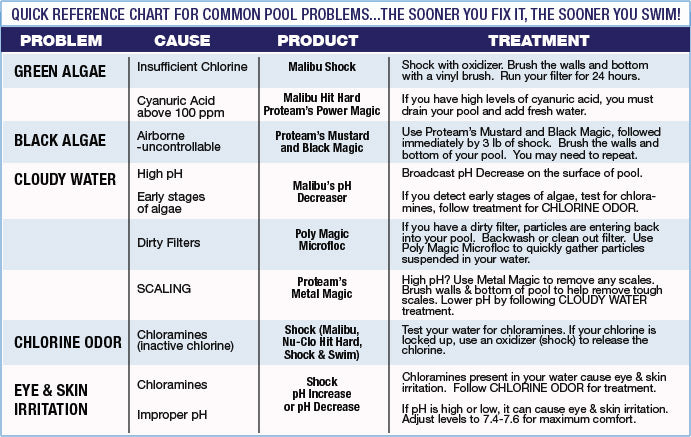
Common Pool Problems
Below is a list of the 5 most common pool problems is above ground swimming pools:
- Green Algae
- Black Algae
- Cloudy Water
- Chlorine Odor
- Eye and Skin Irritation
Water Hardness
Water hardness in a pool is a very important part of balancing water chemistry. If water has too little hardness, it will be aggressive water. This aggressive nature of water will need to satisfy its mineral appetite. If there are not enough minerals in solution to satisfy it, the water will look places to satisfy its mineral hunger. The surface of plaster pools and spas are very vulnerable to this search for minerals. Pool heaters are also very vulnerable. Pool water should seek a hardness rating of 175 - 225 PPM.
How Temperature affects Hardness
The aggressiveness of the water changes with the temperature of the water.
- When the water is cold, it looks to dissolve calcium from the surface and equipment.
This will result in corrosion or etching of the pool surface. - When the water is warm, it forces the minerals out of the solution and is more likely to form scale.
If hardness is high, the water will tend to form scale on the surfaces of the pool such as the plumbing, equipment, liner, and heater; especially if the water temperature is high. The only way to lower the hardness is to drain some of the water and add water from a new water source, or to use a chemical product. For decreasing the hardness in your pool, American Sale recommends Proteam Metal Magic. If the hardness is low, the water will corrode the pool equipment and plumbing and may also etch the pool surface. This tendency is also intensified if the pH and the total alkalinity are low. Plaster pools are very susceptible because the surface is very rich in calcium. For increasing the hardness in your pool, American Sale recommends Proteam Calcium Up.
Testing Pool Water
American Sale offers FREE computerized water testing at all locations. Just bring in a sample of your water and we will test it.
- - Rinse bottle with pool water to be sampled.
- - Take sample from deep end of pool away from return lines.
- - Dip bottle 18 inches below water surface.
- - Fill bottle with pool water.
- - Bring to the nearest American Sale.
Before balancing your water, you will have to test it first. You should test the water frequently. Many factors contribute to the alteration of your water, such as weather and any chemical additions. Testing your water regularly will let you know exactly where you stand with your water ... and help prevent possible future problems. Below you will find the ideal ranges for your pool water:
What To TestChlorine |
Ideal Range1 - 3 ppm |
Shocking Your Pool
When nitrogenous compounds enter a pool the Chlorine is attracted to them. When Chlorine and Nitrogen come in contact they form Chloramines or Combined Chlorine. Nitrogen is a colorless odorless gas. It is a common element found in urine, perspiration, cosmetics, lotions, rain, and fertilizer. When Chlorine and Nitrogen combine to form Chloramines, the chlorine is no longer free to kill bacteria as effectively as Free Available Chlorine. This many times will make the water smell bad with chlorine like smell, irritate swimmers nose and eyes, and look cloudy or dull. To clean up Chloramines, the pool must be shocked.
Shocking a Pool
To destroy Chloramines, the Free Available Chlorine in the pool must be raised to over 10 ppm. It is important to raise the level over 10 ppm because if the level is not brought over 10 ppm the Chlorine will not break down the Chloramines in the water. Breakpoint Chlorination also oxidizes body oils, perspiration, urine, and suntan oils in the water. American Sale recommends Malibu Power Shock or Malibu Shock Hard for effective shocking of a pool. It is important to shock your pool regularly to control the chloramines.

Things to Remember when Shocking your Pool
It is important to leave the pool uncovered for at least 8 hours after shocking your pool. For indoor pools, it is also important to provide adequate air circulations. Lastly, it is important to provide adequate time for this reaction to occur. It is best to perform this on a schedule that controls the buildup of chloramines. The frequency in which you should shock your pool is affected by the amount of nitrogen introduced into the water. Some things that will effect this is the number, age, and type of swimmers, the amount of rain and ground water runoff, the geographic location of the pool, and the exposure of fertilizers to the pool.
Shock and Swim
Chlorine is not the only oxidizer that destroys chloramines. Proteam Shock and Swim (potassium monopersulfate) destroys Chloramines. Any potassium monopersulfate added to the water will destroy as many chloramines as it can without needing to achieve a high breakpoint level. For Shocking without the use of Chlorine, American Sale recommends using Proteam Shock and Swim.
Chlorine
Chlorine is the most common form of sanitizer used in pools today. Chlorine's job is to keep your water crystal clear and provide you with a safe environment to swim. It achieves this by killing bacteria and algae and oxidizing (burning up) any particles to small for your filter to remove.
How Chlorine Works
Chlorine that purchased is typically combined with other compounds to be safe to handle. Once the chlorine comes in contact with water, it changes to an active form that kills bacteria and algae in your pool. This killing form is called hypochlorous acid. As the chlorine destroys the bad guys, the chlorine level in your pool will be reduced or get used. Sunlight and splashing will deplete your chlorine level. This is the main reason it is important to keep proper levels of chlorine in your pool at all times. With all of these factors diminishing your chlorine level, there is not much available chlorine to fight off any other bad guys that your water may come in contact with.
Types of Chlorine
There are two types of stabilized chlorine:
Dichlor
DICHLORO-S-TRIAZINETRIONE, or called sodium dichlor, has 65% available chlorine. Dichlor is a white granular form of chlorine that has a slightly low pH, but for the most part can be considered neutral. Since dichlor comes in granular form, you cannot use it in chlorine feeders or automatic chlorinators. Dichlor dissolves fast when added to water American Sale recommends to pre-dissolve it in a bucket of water before use.
Trichlor
TRICHLOR-S-TRIAZINETRIONE, or more commonly known as trichlor, has 89% available chlorine. Trichlor dissolves slowly into pool water, therefore is found mostly in tablet or stick form. These tablets and/or sticks are placed in a chlorine feeder or automatic chlorinator to help maintain proper levels of chlorine. Using an automatic chlorinator or feeder eliminates the hassle of constantly adding chlorine to your pool water. Most chlorinators and feeders can hold a one to four week supply of chlorine, and can be adjusted if the demand for more chlorine is needed. You will find that when there is more sun or when you have more swimmers than usual, you will need to increase the amount of chlorine feeding into your pool.
Unstabilized Chlorine
Unstabilized chlorine does not have an UV protector. Unstabilized chlorine is available in liquid or granular form. The different types of unstabilized chlorine are: sodium or calcium hypochlorite.
Sodium Hypochlorite
Sodium Hypochlorite is also known as liquid chlorine. Chlorine in this form is easy to use and quickly increases the chlorine level. Liquid chlorine has a pH about 13 ... with 12% to 13% active chlorine. Since liquid chlorine is not stabilized, sunlight will cause the chlorine to dissipate quickly. You will need to add more chlorine because of this and need to add it more frequently. Liquid chlorine does NOT have a long shelf life. The longer it is stored, the weaker the chlorine gets, so make sure when purchasing liquid chlorine to use the product within a short period of time.
Liquid Chlorine will add a tremendous amount of total dissolved solids (TDS) to your water, making all your other chemicals less effective.
Calcium Hypochlorite
Calcium hypochlorite is a white powder with a high pH of 11.8 and 65% active chlorine. Like liquid chlorine, it will dissipate quickly with sunlight. However, calcium hypochlorite is stable and can be stored for long periods of time, unlike liquid chlorine. This product should be stored in a dry, cool place and can ignite if contaminated.Comparing Stabilized and UnstabilizedOn average, 3 ounces of trichlor will give about the same sanitizing power that one-gallon of liquid chlorine or a 1 lb. bag of calcium hypochlorite. We definitely recommend stabilized trichlor because of this. A majority of our customers use trichlor because of these benefits:
- Easier to store
- You'll use less chlorine
- Only needs attention once a week
- Costs less per season
Stabilized chlorine is definitely the better bang for your buck!
Green Grass is Good-Green Pool Water is NOT!
Now that your pool is properly balanced, you must not forget to sanitize it. The biggest problem with pools is algae, the biggest reason why, is not enough chlorine. To maintain crystal clear, bacteria free water, you can use any of the different types of chlorine discussed. You should keep the chlorine level in a range of 1 to 3 ppm. Your water will remain sanitary as long as the chlorine level does not drop below 1 ppm.
Every day your chlorine usage is different. This is dependent on many factors such as how many swimmers, weather, as well as dirt and debris in your pool water. The more factors present, the more your chlorine is being used. Since the amount of chlorine in your water is changing everyday, it is recommended that you test your water chlorine level daily.
What's that smell?
If your pool water smells like there's too much chlorine, actually it's telling you there's not enough. When you add active chlorine to your pool, it automatically begins to do its job by attacking any algae and bacteria present in the water. The chlorine that was used is now called combined chlorine. The chlorine remaining that can still be used to fight is called free chlorine. Only free chlorine is left as the active chlorine to keep your water sanitized.
Combined chlorine, or chloramines is chlorine being tied up by ammonia groups. These chloramines are what cause skin and eye irritation and also that strong chlorine odor that everyone has experienced. When chlorine is tied-up in chloramines, it is not an effective sanitizer.
There are test strips that test for free chlorine and total chlorine. Ideally, total chlorine should equal free chlorine, which tells you none of your chlorine is being tied-up. If you show a high amount of total chlorine, but hardly any reading on free chlorine, your test kit is telling you that your chlorine is being tied up in chloramines. In order to activate this chlorine you must superchlorinate ... or shock your pool water.
Shocking your water means bringing your chlorine level up to 10 ppm. Once you raise your chlorine level to this range, the chloramines will break down and free your chlorine that has been tied up. You should shock your pool on a bi-weekly basis or as often as needed.
Just because you shocked your pool does not mean you can refrain from chlorinating the rest of the week. As you might have read, some of your chlorine is used up right away, some is held on reserve. After the shocking, as part of normal maintenance, you should always add a routine amount of chlorine to your water once your chlorine level returns to 3 ppm.
What if you need to shock your pool and you have a party in 2 hours? There is another chemical you can purchase made by Proteam called Shock and Swim. Shock and Swim is a chlorine free shock, which allows you to swim in 15 minutes!
Closing Your Pool
Quick Tips on How to Close Your Pool
- Make sure before you start that you have all the proper materials needed
- Add winterizing chemicals (make sure they are pre-dissolved)
- Choose what type of winterizing plate you are going to use on your pool
- Drain your pool (if needed)
- Wedge a plug in the return fitting
- Disassemble and clean your filter
- Store your filter in a dry, warm area
- Check for correct cover size
- Loop cable through eyelets
- Inflate and tie up ice compensator
- Fasten cover to pool
- Use Cover Clips or Water Tubes
Closing your pool properly is very important. Properly closing your pool will greatly impact how much time you spend on opening your pool in the spring. If you cut corners, your pool will show it.
Do you have everything you need?
First before starting anything, make sure you have all the supplies you need to complete closing your pool:
- Cover
- Skimmer face plate
- Cable and Winch
- Cover Clips
- Winterizing Chemicals
- Water Tubes
- Ice Compensator
- Main Drain Cap (if you have a bottom drain)
- Air pump to blow the water out of the bottom drain plug plumbing (Hairdryer, Wet/Dry Vac, Compressor)
- Screwdriver - Flathead and Phillips
- Return fitting plug
- Gizmo skimmer protector (for in-ground pools)
Adding Chemicals
The addition of chemicals is very important in closing your pool. You don't want to add just any type of chemicals, but rather winterizing chemicals. Winterizing chemicals have higher concentrations of what you're adding into your pool, which will last the duration of the winter months.
Balance the water chemistry
- Adjust PH to 7.2-7.6
- Adjust Total Alkalinity to 80-120ppm
- Adjust Hardness to 180-220ppm
- Vacuum pool to remove any debris on the bottom such as leaves or dirt
- Vacuuming the debris will leave less chance for algae over the winter season
Purchase the correct size Malibu Winter Kit
There are 3 sizes. Please remember to follow all instructions on the labels of each product for complete application instructions.
Add Malibu Winterizing Powder to your pool.
This magic formula gives you double protection against algae and keeps your pool crystal clear for the entire season into spring.
Add Malibu Liquid Super Strength Winterizing Gallon
For the extra protection you need.
Add Winter Alkalizer
This is a PH stabilizer which helps prevent the PH from changing during the winter months. A PH that varies may cause extensive corrosion to pool equipment.
Add Winter Chlor to pool
Will maintain your chlorine residual as long as possible after closing your pool. This helps keep water algae-free during winter. Circulate the water for ½ hour. Add Metal Out to help keep metals present in your water from staining the liner over the winter. Place Grease Monkey oil absorber in the water to soak up contaminants that enter the water throughout the winter.
Circulate Filter for 3 hrs
Circulating the filter for 3 hrs will allow a good dispersion of the closing chemicals.
**NOTE** These kits are made to provide protection for your pool water all through the winter season, until you once again open your pool. Inferior kits are on the market. These inferior kits do not give you protection throughout the whole off season. Inferior kits will result in an ugly mess come spring and cost more in start up chemicals than a quality kit.
Aquador Face Plate
With the Aquador, your first year you must drain your pool below the skimmer opening to install the plate, but after that initial year, you'll never have to drain your pool again!
First, remove the skimmer face plate. Using the screws that you removed from the skimmer face plate, install the Aquador face plate. You install this from the inside of your pool. Do not use power tools to attach the Aquador, and avoid over tightening the screws. Over tightening can cause the faceplate to crack. The Aquador faceplate is permanent, and will then stay attached to your skimmer. The Aquador winterizing plate is a bit different than a traditional face plate. It is a clear, flexible plastic door that looks similar to a tupperware lid. This snaps onto the Aquador face plate preventing any water from escaping.
The following years after installing the Aquador, all you do is snap the lid onto the housing, and you're done! No more tools or hassles of draining your pool. Now when you open your pool, you don't have to wait for your pool to fill, you can get started immediately. The Aquador is a great system that saves you time, which means more enjoyment in your pool.
Doughboy Pools
Doughboy makes a winterizing plate specifically for its own pools.With this system, you want to drain your pool 4 - 6 inches below the skimmer. Loosen the face plate screws, but do not remove them. This should give you enough room to remove the skimmer, but leave the skimmer face plate loosely attached. Use the same gaskets from the skimmer if they are in good shape. If they are worn, replace them with the ones provided in your winterizing plate kit. Position the winterizing plate from the outside of the pool over the skimmer opening. Make sure the screws are through the openings on the gasket, and then align the holes in the winterizing plate. Make sure not to over tighten the screws, otherwise it can cause the winterizing plate to crack. Aquador also makes a winterizing plate that is made to fit a Doughboy skimmer opening. Follow the instructions for Aquador on how to install.
Return Fitting Plug
After deciding the skimmer face plate, choose a return fitting plug size. You can purchase a small plug, and just plug up the eyeball of your return fitting, or you can take apart the return and seal the entire opening with a larger plug. Either plug will perform the same task. The plug has a wing nut that you can tighten that causes the rubber plug to expand inside the opening. This fills the gap and restricts water flow. If you have an inground pool, insert a Gizmo skimmer protector to prevent water and debris from getting down into your pipes and also to absorb the force of any ice that may freeze inside the skimmer over the winter. Drain your water below the skimmer if you do not use an Aquador face plate.
Filter
Now that all of the openings are covered, you can dissemble the hoses and filter. Unclamp each hose from the filter and the pool. Also, empty any media out of the tank. Replace the media the following season. Hose down and clean the filter tank. Make sure to wipe out and completely dry the inside of your tank. Store your tank somewhere indoors (i.e. garage, shed). Take any hose adapters, clamps, etc. and store them in the strainer to keep from losing them.
Caution: Do NOT leave media inside your tank, or leave your tank outdoors. Both actions can cause any water left in the tank to freeze. Water freezing can lead to your filter tank cracking.Putting on your Cover
First what you want to do is to make sure you have the right cover. On your cover, it should read two different sizes. The first size is what pool size the cover is made for, and the second size is the actual size of the cover. Your winter cover should be 3feet larger that your actual pool size. So for a 24 foot pool, the actual cover size will be 27 feet. Make sure to check the label before putting your cover on. This can save you valuable time if it is not the right size.
Next, what you want to do is begin weaving the cable in and out of the eyelets of your cover. Then, inflate the ice compensator and tie it loosely so that it floats in the center of the pool. Make sure to only fill the ice compensator half full. If you fill it too much, it can cause the ice compensator to burst. Slide the cover over the pillow and rails of your pool. Secure the pool cover by attaching the cable into the winch. Tighten the winch, and your cover will secure itself under the rails of your pool.
What else can I do?
Keeping your cover from flying off can be difficult depending on where you live. Some areas have strong winds that can catch beneath the cover, causing the cover to fly up. Here are a few ways that can help your cover from becoming a parachute.
Cover Clips
Cover Clips can be used either on its own or in conjunction with the cable and winch. These clips are made of a heavy plastic, that snap the cover onto the underside of your pool rail. You want to space these clips evenly apart all the way around your pool. Read the packaging to find out how many clips you need on your size pool.
Water Tubes
Using water tubes is another way to help keep your cover secure. Fill the tubes up with either pool water or water from a hose. Then space these tubes out on the rails of your pool. Tubes work excellent also if you have a deck or walk-around where you can not secure a cable. In addition to these tips, you can also spray an inch or so of water on top of your cover. The weight of the water will help keep the wind from getting under your cover.
Choosing a Pool Table
When choosing a pool table, there seems like there are too many options to select from. You can break down the style of a furniture style pool table by using the process of elimination. First, figure out what color stain you would like, then which type of wood and finally the design of the leg. Let's go over these in more detail.
Stain Color
The stain color of a table is one of the most important things to decide when choosing a pool table. Many customers decide the stain color based on the other furniture or trim in the room that the pool table is going into. Usually most furniture style tables are going in finished basements. Most of these basements have been recently finished and there is no other existing furniture so that allows you to let the pool table be the center piece of the room and you can then choose which ever color you like the most. So this step usually is a matter of opinion. Some different stain color choices that are available from Legacy Billiards are Tradition Mahogany, Traditional Oak, Black Cherry, Black Onyx, Nutmeg, Burnished Mahogany and Distressed Walnut. American Sale also carries tables that are 2-toned with a mix of Black Onyx and Traditional Mahogany which have been a very popular choice among pool table shoppers.
Wood Grain
Deciding the wood grain of a pool table goes hand in hand with deciding the stain color. It is a matter of personal opinion and is usually matched with wood trim and other furniture in the room the pool table is going into. There are three main types of wood grain that you can choose from. Most pool tables are made of oak, maple, or Asian Maple (Hevea brasiliensis). Oak is a popular choice because of the heavy grains found in the wood gives it a classic look. Maple has increase in popularity every year as many people like the clean, smooth look that maple offers. The Hevea tree which is most commonly grown in Southeast Asia has the look of oak and maple. It has a light grain but is most common to maple, hence the nickname of Asian Maple. Hevea wood is used to build many household furniture pieces like coffee tables, end tables, and dressers. Most people have pieces of furniture in their home made of Hevea and don't even know it. Some companies even offer giving the table a distressed look. That may be something that is standard on some tables or a special order option for others.
Leg Design
There are many different designs of legs out there. Some of the more common ones are Ball in Claw, Rams Head, Queen Anne, and Box leg designs. The Ball in Claw is the most common because it is also a common look on the legs of dining room chairs and tables. It has the look of a claw of a bird that has a sphere in its grasp. The Rams Head leg gets its name from the ram's horn design carved on each side of the legs on the pool table. The Queen Anne leg is also very common on other household furniture like the ball in claw leg. It gets its name from Queen Anne herself who preferred this style of architecture back in the late 1800's. Although the interpretation of the design of the leg was very vague it has taken on many different variations. This style of leg is getting more and more popular because of its clean look and smooth lines. Another style of leg that is gaining in popularity is the box leg. The box leg gives the pool table a very masculine look. Most tables that have the box leg have straight lines and right angles. Trends show that pool table buyers are staying away from very ornate tables. Pool table companies are always trying to come out with something new so they can be on the cutting edge of the industry, but these four styles of legs never go away.
Now after you have gone through these three steps you should have narrowed down your choice of tables to just two or three if not one. The last piece of the puzzle is picking out the cloth for the table. This is a very important decision because sometimes the cloth can change the appearance of the table drastically. The color choice can lighten or darken the look of the stain color on your table so be sure to lay a sample of the cloth on the wood to make sure you are happy with it.
Billiards Dimension Chart
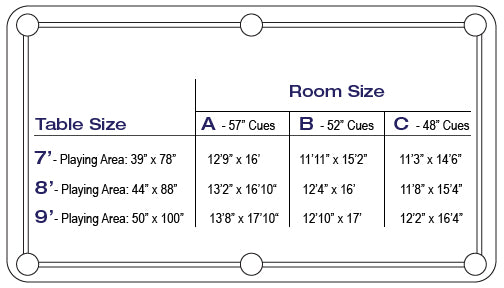
The most important factor when purchasing a pool table is the area where the pool table will be placed. If there is insufficient room around the table to maneuver a cue, play will be hampered. Below is a size chart laying out the area needed for three popular table sizes. Always place the pool table in the center for maximum play area. Room Dimension Chart
- A - Room size for 57" Cues
- B - Room size for 52" Cues
- C - Room size for 48" Cues
Trouble Shooter cues are always an option. These are perfect for tight areas around a wall or support beam. What makes a Trouble Shooter cue such a great choice is they are weighted in a way that gives them the weight of a normal cue and can be used in awkward areas. The Trouble Shooter is available in lengths of 24", 36", 42", 48" and 52".
PATIO FURNITURE MATERIAL
Aluminum Furniture
Why choose aluminum patio furniture? Aluminum is an extremely strong and durable metal with low maintenance. Aluminum does not rust , as compared to steel furniture. Because aluminum is such a low maintenance material, it is considered a smart purchase.
Aluminum can be formed into many styles and designs. Many of American Sale's sets have the combination of traditional tubular along with extruded aluminum. Castings are decorative design details that add beauty and strength. Castings are made by pouring hot molten aluminum into a mold. The metal cools and hardens into the shape of the mold. These castings enhance the design of the furniture and also add weight making them able to withstand windy areas such as lake sides or balconies.
Extruded or Cast Aluminum
When looking at the arm of a chair and you see the same shape of aluminum tube from one end to the other, the arm is made of extruded aluminum. This means it began at one straight aluminum tube and when it was processed was cut, bent, welded and painted. A cast aluminum chair may have a scroll or an arm that is wider or narrower. These molded designs are added to the frame.
Powder Coating
Aluminum furniture is painted by powder coating. This process electrostatically bakes on a durable chip and static resistant poly paint finish that lasts for many years. This system is also used in the automotive industry.
Maintenance Tip: Simply use a mild, non-abrasive soap with warm water and rinse. Also applying car wax once or twice a year will protect the glossy finish. Do not apply car wax to textured finishes.
Wicker Furniture
There is a wide variety of all weather wicker furniture available. American Sale's wicker furniture is weather resistant PVC wicker, which means the great look of wicker with the durability of a synthetic material. Wicker furniture can also come with hand woven select vinyl on a rust free aluminum frame, which provides durability and has virtually no maintenance.
Maintenance Tip: Our outdoor wicker furniture is constructed with an aluminum or steel frame wrapped with resin/vinyl. Clean this type of furniture by using a mild detergent and rinsing with a garden hose. Unlike natural wicker, this can be done several times a year during the season because the furniture is made to withstand constant moisture.
Wrought Iron
Wrought iron is extremely strong and durable, making it a tremendous value because you will enjoy years of comfort and low-maintenance. Because of its weight, wrought iron furniture is not as susceptible to wind and weather conditions as other types of materials. Top manufacturers use a state-of-the-art epoxy primer system. This special primer system is the same system used to prime car metal before the paint is applied. After the furniture emerges from the primer system, it is thoroughly coated with powder coated finish. Wrought iron can last for many years.Tired of the color? Just spray paint it, it's that easy.
Maintenance Tip: The frames should be washed with automotive type soap and thoroughly rinsed. It is recommended that at least twice a year, you wax your frames with an automotive type wash/wax, or more specifically, where both the wash and wax are contained within the same bottle. The frames should be rinsed again thoroughly to remove any residue. It is strongly recommended that before waxing the frames, the frames should be inspected for chips in the finish, which may occur under normal usage. Any chips or scratches can be easily repaired with touch up paint.
Steel Furniture
Steel Furniture is a great choice for its durability, heavy weight and affordability. Although, steel furniture frames are cleaned, primed and coated for protection it is recommended to touch up steel whenever a chip or scratch occurs. Steel can rust and is not warrantied, but if touch up your steel patio set it can last for many years.
Maintenance Tip: It is recommended to use a mild soap and water when cleaning is necessary. It is recommended to cover your furniture when not in use. It will extend the beauty and cut down on cleaning.
Fabrics
Acrylic Prints
Acrylic prints offer strong color cotton fabrics combined with the weather and satin resistance of acrylic yarns. The designs are printed on 100% solution dyed acrylic cloth. Wash with mild soap and warm water. Rinse and air dry.
Acrylic Jacquard
Acrylic Jacquards are used indoors and outdoors on cushions or umbrellas. This fabric is made of solution dyed yarns which are woven in jacquard patterns. Clean with mild soap and warm water.
Polyester Prints
Poly prints are great indoors or outdoors. Made of 100% polyester breathable yarns which are easy to clean with mild soap and water. Rinse and air dry. This fabric stays cool and comfortable. Do not use bleach.
Vinyl Coated Polyester
PVC coated yarns are designed for outdoor use. This fabric is breathable and provides comfort and strength for cushions, slings and umbrellas. Clean with a mild soap and warn water solution. Rinse and air dry.
Olefin
Olefin is solution dyed and then woven, locking in the true colors for years. Olefin is a soft, comfortable, cool fabric designed for outdoor use. Clean with mild soap and warm water. Rinse and air dry. Avoid contact with suntan lotions and oils.
Patio Tables
Many shoppers think that deciding what type of chair they want may be the only decision that they have to make when picking out a patio set. After shopping around you will find there a lot of chairs to choose from, but you will also have to decide on a table top for your set. The most popular styles of table tops are glass, cast aluminum, marble tile, stone, and synthetic stone tables.
Glass Top Patio Tables
Glass top patio tables have been the most popular style table for many years. The reason glass tables have been so popular is because they are very affordable. Many glass top tables have a steel or aluminum frame with a tempered glass top inserted in the frame. Glass is known to shows dirt and you will find yourself wiping down the table repeatedly. One thing to avoid that problem is to use a patio cover that will keep your set clean, so when you are ready to use it, it is ready for you.
Cast Aluminum Patio Tables
Cast aluminum top tables are our most popular style of table top at American Sale. The benefits to having a cast top table is that you don't have to worry about glass break, cleaning the table is as simple as hosing it down without the worry of water marks, and the paint finish on all of our cast top tables are a baked on finish that will not crack, flake, or peal. On top of all of those benefits, the cast tops are beautiful. There are many different styles and designs from different manufacturers.
Marble Tile & Stone Top Patio Tables
Marble tile tops and stone top tables are very similar. These style tables use actual marble and stone tiles to make up a table top. Most of these tables are extremely beautiful and use many smaller tiles creating a mosaic design. Another advantage is that they are very heavy. It would take an extremely strong wind to flip one of these tables over. One disadvantage to these tables is that you cannot leave them outside during the winter, not even with a cover over them. Because of the natural design of the table the smallest bit of moisture works its way between the tiles and then come winter that small amount of moisture freezes and pops the tiles off the table. So these table tops need to be brought indoors for storage during winter.
Synthetic Stone Patio Tables
The last style of table out there is the synthetic stone table. Synthetic stone tables are made to look like a stone, slate, or marble top table without the maintenance. These tables are made from many different types of materials. The most common type of material used is a resin composite. This resin composite material can not only have the same look as a stone top table but it also has the same feel of a stone or slate top table. The advantages of these style tables are that they have very little maintenance to them. You do not need to worry about cracking of tiles and stones or tiles popping off the table all together. These tables can be stored outside on the patio during the winter with a cover over them just like the cast aluminum tables.
Patio Umbrellas
Patio umbrellas come in many different shapes and sizes. You have cantilever patio umbrellas, market patio umbrellas and garden patio umbrellas. There are also umbrellas that slide open, umbrellas that crank open, push button tilt umbrellas, auto tilt umbrellas and collar tilt umbrellas. Let's start with the different categories of patio umbrellas.
Cantilever Patio Umbrellas
Cantilever umbrellas have been a fast growing trend since the year 2003. A cantilever umbrella is not your typical umbrella that everyone pictures when you say the word umbrella. Most people think of a traditional table umbrella that goes in the hole in the center of a patio table and is screwed into a weighted umbrella base. The cantilever umbrella could not be more different. This style umbrella is designed in a way to hang over the table rather than being held up by a pole. Starting from the ground up there is a base that sits on your patio (not under the table) that is usually weighted down by filling it with sand, decorative patio bricks or anchored down to the patio or deck. From there attached to the base is an aluminum pole that goes up and hangs an umbrella over your area that needs shade. These come in sizes from 9 feet - 13 feet.
There are many advantages of having a cantilever umbrella. You can use it on any type of seating group you may have on your patio whether it is a living area, chat group, or dining area. It is very easy to use the umbrella on different areas of your patio because most cantilever umbrellas have the ability to spin 360 degrees and be used over your dining set, living area, and your hot tub with out having to move the heavy base once. Tilting a cantilever umbrella is another upgrade compared to a traditional patio umbrella. When tilting a cantilever umbrella you have the option to tilt most of them up to 180 degrees.
Garden Patio Umbrellas
Most garden umbrellas are 7.5 feet. They normally have an aluminum chrome colored pole that will fit any 1½" umbrella hole in the center of a patio table. They also normally are equipped with a crank to open the umbrella and offer a push button tilt to adjust the umbrella for better shade. Many garden umbrellas have a hanging valance around the outside edge of the umbrella. Garden umbrellas offer strength and a great look at an affordable price. Garden umbrellas were very popular in the 90's, but around 2002 many consumers started going with the stronger and larger market umbrellas.
Market Patio Umbrellas
Market Umbrellas are available in many different sizes but most commonly found in 9 feet and 11 feet. One of the distinct features of the market umbrellas is the straight edges around the outside of the umbrella. There are no hanging valances which give the market umbrella a very modern sleek look. Another feature commonly found on the market umbrella is the wind vent. A wind vent is an addition piece of fabric found at the top of the umbrella that allows wind to escape from the underneath of the umbrella. Some models also offer a double wind vent to assist in large gust of wind. Market umbrellas also have many different options for styles of poles and tilt options. With market umbrellas you can get a wooden pole or an aluminum pole. Many people like the wooden pole umbrella for a more natural look. A wooden pole market umbrella normally has a draw string pulley system to open the umbrella. By pulling on the draw string you open the umbrella and keep it in the open position by sliding a pin into the pole. If there is no draw string to pull you would just slide the umbrella up the pole and again prop it open with a pin. The only downfall of the wooden pole umbrella is that there is no tilt available. The aluminum pole umbrellas offer a much easier way to open the umbrellas. These umbrellas have crank handles that can open and close the umbrella which make the things easier because you don't have to reach and climb over your patio table to slide in any pins to hold the umbrella open. Also by having an aluminum pole and crank to open and close your umbrella it gives you the option of tilting your umbrella. The different options for tilting your umbrella are push button, auto tilt, and collar tilt.
The Many Different Ways to Tilt Your Umbrella
Having the ability to tilt your umbrella is a very desirable feature. The sun is moving all throughout the day and being able to tilt your umbrella maximizes the amount of shade your umbrella can give you. When it comes to tilting your umbrella there are three different styles of umbrellas that tilt. There are push button tilt umbrellas, auto tilt umbrellas, and collar tilt umbrellas.Push Button Tilt UmbrellasThe push button tilt is the original style of tilting an umbrella. It is very simple. First you crank open your umbrella. After you have the umbrella fully open you reach up towards the button at the top of the pole, hold the button in and with your other hand pull the umbrella down to the side the hinge allows you to and release the button. In order to operate the push button tilt umbrella you need to either be able to reach across the table and up the umbrella pole or use a step stool or ladder to reach the button.
Auto Tilt Umbrellas
The auto tilt umbrella works in a similar fashion to the push button tilt umbrella, but is an upgrade because of its ease of use. Like the push button tilt umbrella the auto tilt umbrella needs to be fully cranked open. Once the umbrella is fully cranked open you must continue to crank the umbrella open to operate the auto tilt mechanism and as you are cranking the umbrella the umbrella automatically tilts without having to push any buttons. This is a much easier way to do things because anyone can operate this umbrella no matter what height you are. No step stools or ladders needed.
Collar Tilt Umbrellas
The collar tilt umbrella is the easiest to operate of all three different types of tilting umbrellas. The collar tilt umbrella operates just like an auto tilt umbrella. In order to tilt a collar tilt umbrella after the umbrella is fully open you simply turn the collar right above the crank mechanism of the umbrella. This is much easier than an auto tilt umbrella because when tilting an auto tilt umbrella cranking the umbrella after it is fully open offers some resistance. When turning the collar on a collar tilt umbrella, it is done with ease. There is no resistance, anyone can do it.
Patio Storage
American Sale recommends the following care tips for inclement weather:
Spring/Summer
Cover your furniture for maximum protection. Remember to close your umbrella when not in use. This not only protects the fabric but also the table due to unexpected storms or high winds. We also recommend covering your umbrella or even removing it from your table in the event of a forthcoming storm.
Fall/Winter
The first step in storing your furniture for the winter is to drain any water that may have accumulated in the frames by turning all pieces upside down. To remove all water from the frames, remove any leg caps or fabric caps located on the chair and tilt upwards on an angle allowing all water to drain from the frames. Water in the frames can freeze and cause expansion in very cold temperatures. This is referred to as "ice damage" and is not covered under warranties provided by the manufacturers.
Remove your umbrella and cushions and store in a dry environment.
For maximum protection, cover your outdoor furniture if you do not have the space to store indoors.
Fuel Sources
Grills typically are available in 4 fuel sources:
-
Propane (LP)
- Liquid Propane grills are very convenient, easy to fill and temperature is easy to control.
-
Natural Gas
- Natural Gas utilizes a home gas line, very cost effective but should be installed by a licensed plumber.
-
Electric
- Electric grills are convenient for apartment and condo owners, can be easily transported and can be used in most locations.
-
Charcoal
- Easy to use, easy to transport and uses either wood or charcoal briquettes.
Cooking Surfaces
Different surfaces provide varying cooking temperatures and distribution of heat. Below is a list of several options:
-
Porcelain-Coated Cast Iron
- Top of the line surface, long lasting and easy to clean
-
Cast Iron
- Retains heat and controls heat very well
-
Stainless
- Durable, no coating to chip, cooks well with slow cooked food
-
Chrome Wire
- A heavy duty surface used in camp grills and grilling accessories
-
Porcelain-Coated Wire
- Non-stick surface, not as durable as Porcelain Coated Cast Iron, cooks evenly
BTU's
A grills BTU rating is calculated by the total amount of heat output per hour utilizing all burners. Grill size, cooking surface and overall design all determine how much heat is produced and not just BTU output.
- High BTUs: Generally high a higher BTU grill generates higher temperatures and is good for frequent grillers
- Low BTUs: Easy to control temperature, great for infrequent grillers
Helpful Hints on Decorating Your Christmas Tree
Step 1- Find a Good Decorating Spot
Set your tree stand in a location that will allow you to move around tree to decorate. If you are using a revolving tree stand, you will not need access to all sides.
Step 2- Assess Your Electrical Needs
If you purchased a real tree or non-pre-lit tree, wrap the "Christmas Tree Extension Cord" (12 ft. Extension with 9 outlets.) down center pole of tree. It will make lighting the tree much easier. If you have a "Power Pole" tree, you will not need to worry about this step. Your tree sections will light when each section is connected to the pole.
Step 3- Fluff or Shape Your Tree Sections
Shape and fluff each branch before putting on the next section. Trees that are color-coded, hinged or foldaway should be shaped from bottom to top. With this method, your tree will be fully assembled and shaped at the same time. When fluffing your branches, they should be slightly bent upwards like they are growing towards the sun. TIP: If you don't want to be "scratched" by the tree material, wear gardening or latex gloves during the fluffing process.
Step 4 - Light Your Non Pre-Lit Tree
If you purchased a non-pre-lit tree, place lights on tree, starting at top. Work in a panel from down one side of tree instead of walking around the tree. To hide wires, work from the center pole out to the front of branch, and then back to the pole. When you are by the pole, cross over to the next branch. NEVER cross over in front of the tree. Do not end to end connect more than 3 sets of lights unless they are L.E.D. lights. If you purchased a pre-lit tree, follow the directions on connecting lights.
Step 5- Drape Your Tree with Garland, Beads, and Ribbon
The first step to decorating is to create a festive scalloped-sway effect by draping garland, beads and ribbon along the branches. Garland outlines the shape of the tree and forms the framework for the rest of the tree trim. Start at the lowest branch level and drape the garland in uniform swags from one main branch tip to the next. Or, place garland on tree in your own desired pattern. Create a your own pattern using each material in a similar effect.
Step 6- Decorate with Ornaments, Bows, Berries, and more!
Place ornaments and novelty decorations in desired patterns. Start with large ornaments first and place symmetrically on tree. Use bows, berries, leafy picks or other items to hide any "holes" and fill up the tree.
Step 7 - Place the Tree Topper On Top of Your Tree
Place and secure treetop on top of tree. This is a good moment to bring everyone into the room for the final look! A fun family memory each year!
Step 8 - Place Your Tree Skirt Around The Tree
Clean up around the base of the tree with a broom or vacuum. Then place your tree skirt around base for a finished look.
How Much You'll Need For Your Tree:
| Tree Size | Miniature Lights Number of Bulbs |
Garland Number of Feet |
Novelty Decorations | Ornaments |
| 4 - 4½ft. | 150-300* | 48'-60' | 18-24 | 24-36 |
| 6 - 6½ft. | 300-500* | 72'-90' | 30-48 | 48-60 |
| 7 - 7½ft. | 550-950* | 100'-120' | 48-60 | 60-72 |
| 9ft. | 800-1200* | 120'-150' | 60-72 | 84-96 |
| 10ft. | 900-1400* | 150'-180' | 84-96 | 96-120 |
| 12ft. | 1000-1500* | 180'-210' | 96-120 | 120-144 |
| 15ft. | 1300-1800* | 210'-240' | 120-144 | 144-160 |
| 18ft. | 1600-2400* | 240'-270' | 144-160 | 172-200 |
| 21ft. | 2000-2600* | 300'-360' | 172-200 | 200-250 |
*Light quantities may vary depending on needle length and tree diameter.
Bean Bag Rules
Setup
The boxes are placed 30 feet apart from the center of the hole to the center of the other hole.
Game Rules
The game can be played with either 2 or 4 players.
Each team has 4 bags to throw.
When 4 players are playing, one member from each team stands at both ends of the boxes.
Each player must throw from behind the front of the box. This is the foul line. The player must not pass the foul line or the player's throw does not count and the bag is removed.
Each team alternates shots beginning with the team that scored the last point.
Scoring
Points are scored when a player has a bag on the board or in the hole.
Only one team can score points per round because points cancel each other out.
A bag put on the board = 1 point
A bag put in the hole = 3 points
The maximum amount of points scored in a single round is 12 points. (4 bags from the same team in the hole) An example of cancellation of points is if one team has 1 bag in the hole and 3 bags on the board and the other team has 2 bags in the hole and none on the board. 3 + 1 + 1 + 1 = 3 + 3 + 0 + 0. If this were to happen in a game the resulting round would be called a wash and the first team to throw in the last round would throw again in the next round.
The game is over when one team scores 21 points, but the winning team must win by 2 points.
A bag that hits another players bag or any other bag is legal and still in play. If a player throws a bag and the result is that it hits the other players bag in the hole, the bag in the hole counts as such. If a player knocks another players bag off of the board, that bag stays off of the board.
A bag that hits the ground for any reason is considered dead. If a bag bounces and lands on the board it is dead and must be removed from the board before play may continue.
Darts Rules
301
The Object
This game is normally played with 1-4 players. The object of the game 301 is to start with a score of 301 and lower your score to exactly zero by throwing 3 darts and take turns with your opponent until someone gets to zero. Every dart that you throw you subtract from 301. Depending on how long you want the game to be you can make this game 401, 501, 601, 701, or 1001.
Strategy
The strategy of this game is to throw as many doubles (the outside ring on a dart board), triples (the inside ring on a dart board), and bull's-eyes (the center circle of a dart board) as possible. The more points you score the quicker you get down to zero. So the highest score that you can subtract off with one round of throwing is 60 (3 triple 20's). The true skill of the game is when you get close to zero to have the aim to get exactly what you need to not go over your "out" number. So if you're out number is 32 then aim for a double 16 so you use the least amount of darts possible.
Optional Rules
To make the game more challenging some players will play with the rules of Double-In and/or Double-Out. These rules mean that in order to start the game and start subtracting points you must first throw a double before any throw counts. And in order to finish a game you must throw a double as your last dart. To decide which player throws first most people play with the rule of Closest to the bull's-eye goes first. That means that each player throws one dart and the dart that is closer to the bull's-eye gets to start first. Otherwise this can be decided with a simple flip of a coin.
Cricket
The Object
This game is normally played with 1-4 players. Each player takes turns throwing three darts. The object of Cricket is to "close" all of your numbers (20 – 15 and bull's-eye) before your opponents do and also have a higher score. In order to "close" a number you must hit that number three times with any combination of singles, doubles, or triples. To score points, you must first close out a number and then every dart that you hit on a closed out number adds to your total score until all of your opponents close out that number also. After all of the players close out a specific number then no one can score points of that number.
Strategy
Since the object of the game is to close out all of your numbers as quick as possible then the strategy is pretty simple, aim for the triple rings. If you can hit a triple ring on a number from 15-20 then you will close out that number with one dart.
Optional Rules
To make the game more challenging some players will play with the rules of "Double-In". This rule means that in order to start the game and start closing out numbers you must first throw a double before any throw counts.
To decide which player throws first most people play with the rule of "Closest to the bull's-eye goes first." That means that each player throws one dart and whoever's dart is closer to the bull's-eye gets to start first. Otherwise this can be decided with a simple flip of a coin.
Around the Clock
The Object
This game is usually played with 1-4 players. The object of this game is very simple. Each player takes turns throwing three darts at a time and tries to hit every number on the dart board in order. So the first number you aim for is 1 and then once you hit 1 you move on to 2 and so on. Once someone gets to 20 they win.
Optional Rules
To make the game more challenging you can add doubles, triples, and bull's-eyes to the "clock".
To decide which player throws first most people play with the rule of "Closest to the bull's-eye goes first." That means that each player throws one dart and whoever's dart is closer to the bull's-eye gets to start first. Otherwise this can be decided with a simple flip of a coin.
Washers Rules
Number of players:
2 or 4 – singles (1 vs. 1) or partners (2 vs. 2)
Object of Game
Points are made by tossing washers into the box or the pipe in the center of the box. If a washer is made in the box that players receives one point and if a washer is made in the center pipe that player receives 3 points. When a player throws they are not allowed to step past the front of the box. First person or team to score 21 points wins.
Optional Rules
- For highly skilled players the rule can be added that the first person or team to score 21 points exactly without going over 21 points wins.
- If the washer lands on the box, that throw receives 2 points.
- For less skilled players the game can be played with the scoring of receiving 1 point for tossing the washer within one foot of the box, 3 points for tossing the washer in the box, and 5 points for tossing the washer in the center pipe. This helps makes the games go by faster so more teams can play.
Set up
Make sure the boxes on placed on even ground 20 feet apart from each other.Game Play SummaryWhen playing a singles game the two players stand on the same side of the "playing field" and shoot towards the same box. If a team game is being played (let's say Team Red vs. Team Blue) then one player from the Red team and one player from the Blue team each stands on one side and the other 2 players stand on the other side. Flip a coin to see who throws first and then each team rotates throws until all 4 washers have been thrown for both teams. Then the team that scored last gets to throw first for the next round of 4 washers being thrown until one team reaches 21 points. If it is a singles game then you move to the opposite box for each round. If it is a team game then each side takes turns throwing back and forth. If both players get a washer in the box or center pipe, they cancel each other out like in a game of horseshoes.
Example: If player 1 throws and gets 2 in the center pipe and 1 in the box, they would have 7 points. If player 2 threw and got 1 in the center pipe and 2 in the box, they would have 5 points. These cancel each other out and player 1 gets 2 points because you subtract 5 from 7 to equal 2 points.